Monday, June 23, 2014

The Science Project Complete!

    In August of last year I blogged about the Science Project, a project fellow PCV Evan Cobb and I came up with.  The purpose of the Science Project is to bring science experiments and science education to classrooms throughout Cambodia who do not have the resources or wherewithal to obtain it.  While Evan slaved away fixing up the lab all shiny and new for the kids and science teachers, I worked on the putting the book together with PCV Rich Durnan, and expert on the computer.

The room before and during renovation.

Our science book! Woooo!


I am so happy and proud to say that our little Science Project is a huge success.

    How can I make such claims? Well, a few months ago I traveled to Evan's site to pilot the class for the kids. They were super excited, he told me.  After a snafu or two, I arrived at his site and his school to find that the entire first class was waiting for me and ready to perform experiments.  An added bonus? The science teachers from his school were also ready.  They were sitting in the room with the kids wanting to hear what I had to say, and to observe these experiments we had spoken so often about.

    I had made a few posters the night before so we hung them on the walls and got down to business.  Since I was only able to see two classes (the 12th graders), Evan and I decided to try and tackle three separate subjects/experiments, each at about 20 minutes long allowing for a short explanation and questions at the end.  The first experiment we did was a rocket on (a la volcano) involving the use of, you guessed it, baking soda and vinegar.  I wrote the chemical reaction on the board and attempted to draw the chemicals by way of a short explanation.  A great part of this story is that the chemistry teacher came over and corrected my drawing.  I was ecstatic.  "Please," I said to him in Khmer, "continue."  The purpose of this project wasn't for me to teach the kids, it was for Evan and me to introduce them to the subjects and for the teachers and students themselves to take over and use it at their own pleasure.  But he wasn't interested, he wanted to see what I had to offer.

    Usually this experiment is done with a film canister (at least that's the way I did it, way back when), but those are difficult to find in Cambodia (and the rest of the world...thank you digital cameras) so we were flexible with a medicine bottle that had a snap-off lid (for a good how-to of the experiment, see here).  I showed the kids how to do it once, by wetting baking soda, padding it into the top, and filling the canister with vinegar.  Then I capped the bottle, turned it over, and stepped back expectantly.  There was a small hiccup and a fizz - I had filled the vinegar with the wrong amount of vinegar, and after cleaning the materials up, stepped back for the kids to have a try.  See below:


And they trial-and-error-ed it until the last one we had time for, when the bottle flew up like a rocket! Reactions were perfect and I think I literally clapped my hands together in excitement.  But no time to dwell, the 20 minutes were up!


   For the next science exposure, Evan and I chose to use a microscope and show the kids mitosis.  I tried to give them a brief overview of what they were going to see but mitosis is pretty complicated to explain in a short period of time via a foreign language.  So using the posters I had made the night before, I showed them the stages and we set the microscope up.  They "ooh'd" and "ahhh'd" and once more: success.


   The third experiment involved two glass bottles that were the same size but one was filled with water and the other empty.  They were set up on a ramp made of books and the students guessed which would roll faster and farther.  Behind the experiment we told them a little bit about friction and why the bottles traveled like they did.

   Thus ended our first class and we were pretty happy that it went well.  The second class was even better because the science teachers ended up practically taking over! Incredible to see, and happy that my work in that classroom was basically done.  Not only that, but after the class, a few of the students came up to me to ask about getting more information on studying science! If that doesn't signal success, I'm not sure what does.

   We have passed the books to other Volunteers and last week Evan traveled to the site of another Volunteer in order to give a presentation.  Spread the science around, I say.


Now onto the next province.

xo
Amanda


*all photos were taking by Evan Cobb

**check out our project featured on the Peace Corps Cambodia Webpage.

***or here on Facebook!

****to any other PCV who wants to check out the book and *!*use it at their school*!*, contact me for a pdf.  Spread it around!


Top: Evan with the students
Bottom: Me with the other class

Friday, May 30, 2014

Languages

     I am now held in the firm belief that communication is the root of life as we know it.  How I never considered that life could not continue without communication while studying the very social human species all through college is completely beyond me.  I guess I could just say that I was conducting a firsthand experiment and have just now had ample time to explore the relationship of people and subsequent relationships along with their language use. 
     Growing up and being a native English speaker in a world that increasingly uses English to communicate internationally, I am in a unique position – one where, living in America, speaking a language other than English is more of a hobby or “thing to know” rather than a necessity for life, job security, or survival.  Outside of America, this is not so much a fact as an illusion and lucky me, I am now living outside of America.  Here in Cambodia, and other parts of the world, children are taught to speak English and languages other than the native language beginning in primary school. 

     Sokchea has been learning the English language since far before I came to live in the room upstairs.  In primary school he started learning, and now, at 13 years old, he still goes to English lessons (he is learning how to type, too).  Sometimes he asks me what words mean but more often than not, I am asking him.  Recently I tried to explain to my host mom the half-marathon in Siem Reap.  “Knyom tao Siem Reap sumraap roat hutbraan,” I will say to her, I am going to Siem Reap to run.  She doesn’t understand.  I run outside on the road, why would I have to go all the way to Siem Reap to do the same thing I can do on the road outside?  “Sokchea,” I ask, “race, ta meich?” how do you say, “race”? and he will ask me to spell it – and then give a translation which I repeat and attempt (usually failing) to commit it to memory for its use later.

     My host mom told my visiting program manager that Sokchea was first in his English class and she attributed his great language skills to my help.  It had nothing to do with me, let me tell you, that boy is crazy smart.

     He also knows that to rise in his world, speaking English is necessary.  For Sokchea to continue on to higher education, speaking English is necessary.  For most jobs in cities where he would hope to earn a decent paycheck and support his family, speaking English is necessary.  To even use many programs on the computer, reading English is necessary. 

     Just a few nights ago my host mom was putting on some sweet smelling lotion.  Ka-oab I said, having recently learned the difference between the Khmer word for something that smells good that you will eat and something that smells good that you will not eat.  My host mom smiled. Ka-oab? She asked me and I thought for a moment, “fragrant,” I responded.  She tried to pronounce it and Sockchea said, “good smell, Bong?” I nodded, “trau” correct. 

     Man Kheang randomly interjects, “Ch’guy-Ahnglay-dog” … “Chmaw-Ahnglay-cat” … “Laan-Ahnglay-car,” saying the Khmer word, “English” and then the English word that he has learned. 

“IPad Ahnglay IPad,” Man walks around saying, chuckling at his little joke. 

     Some words just make sense-the kind of words you learn and learn to translate and say, why didn’t we do something like that? For example, when asking someone for the check in Khmer, you say gut loy, literally think of money.  How cool is that?  And the word “cool” is one of my favorites: it sounds like low-ey which is very similar to the word for “Money” (loy) and so when the kids say something is low-ey, I always imagine them saying “money” like, Bong, this spiderman costume is money! Ha. The word may is also one of my favorites, because it means “boss” and also “mother” – proving that Khmer people have gotten more than one thing straight while composing their language.
     Then there are the Khmer words which are decidedly English, just with a different location for the accent mark.  For example: “internet,” “computer,” “magazine,” and of course “beer,” are all words that have been adopted from the English language and are very easy to translate here; just put the accent at the end of the word and Cambodian people who do not speak English will understand what you are saying. 

     One afternoon a few months ago, Man Kheang came up to my room and asked me to teach him how to write his name in English.  I carefully wrote out his name for him in my best handwriting, and he painstakingly copied it just below on the same page.  As he held it up proudly to show me, I thought at that moment that I understood why teachers choose their careers and stay in the classroom long after their students leave.  In front of me sat a pleased little Khmer boy who had just written his name in my language, grinning like a madman at his accomplishment.  

And I, for one, had never been so proud.


xo-Amanda

Sunday, April 27, 2014

Camp GLOW

Greetings!

After a little hiatus I am back! With the last project of my service about to begin.  I am talking about Camp GLOW.  

You may recall me posting earlier* (a little less than a year ago) about the Camp GLOW I and some other PCVs put on in Kampot Town (for a refresher, check out this video** https://www.youtube.com/watch?v=DpoEIMT-NwA&feature=youtu.be) which was the first one Kampot PCVs had brought to Kampot Province.  Now we are on the verge of the second Kampot Camp GLOW! 

Camp GLOW is a stellar example of the legacy of Peace Corps service. The first such camp was established by Peace Corps Volunteers in Romania 15 years ago. Since 1995, Volunteers in 60 countries have established similar programs to promote the empowerment of women.  The concept has been adapted and developed since originally conceived, with one group of Volunteers passing along the lessons learned to the next group of Volunteers who serve as counselors and mentors.

The girls had a terrific time last year and this year we are looking forward to putting on an even better camp! 

In order to complete this dream, we need some help! We are trying to raise money for the camp in time to have it at the end of May. Every little bit helps! Please donate if you can, or pass the link on if you can't.  
To donate or check on our progress, click here*: https://donate.peacecorps.gov/index.cfm?shell=donate.contribute.projDetail&projdesc=14-303-015
THANK YOU!!!!

xo-Amanda


*check out June 2013 for my post about our hugely successful Kampot Camp GLOW 2013!

**sorry! my link button isn't working! please work with me here, and copy and past the URL. THANKS!

Wednesday, March 19, 2014

Libraries and Books

I have an addiction.

   It's plagued me since childhood and I think it's time to tell the world that I can't stop and I can't give it up.  There have been enablers throughout the disease: my parents, my friends, even the occasional librarian.  At an early age my parents cut off financial support for my addiction but the encouragement did not wane.  Through the years it's been my route to friends and clubs, boring those who didn't share my interest and leading me to rare fellow addicts who, like me, cannot get enough of our high.  My affliction is this: I am addicted to the written word.

   My love affair with books began as soon as I  became literate, likely the reason I have such terrible eyesight.  I would read past bedtime under the covers with a flashlight (Sorry Mom, thought now I am sure you already knew) and by the third grade I was allowed to take out three books instead of the standard two from the school library.  Ah, books.  Just the thought of good literature puts a smile on my face and relaxation in my bones.  I am convinced that the human race is not doomed as long as my favorite authors circle the world in a cycle of publishing, lending, and pirating.  Even now, when I have confessed my sins of constant reading, sometimes to the neglect of homework or dinner, to share my passion of books makes me want to have a conversation instead of this one-sided blog - just to see what everyone is reading!

  And in honor of books, because everyone should have as much assess to the written word as possible, and also because the school director at my site asked me for some help, I have started a Library/Meeting Room Project to finish off my service (YAY!). 

   The project started as a library project.  After meeting with the school director he showed me a room with a pitiful stand of books that the students are able to read and asked if there was anything I could do.  There was.  As part of the project, we are remodeling a room at the school: adding tiles to the floor, paint to the walls, tables and bookshelves along with benches and tables, and then filling the whole place with BOOKS!
   The project also has a sporting aspect because some kids just aren't into books, but that doesn't mean they can't utilize the space! So instead of checking out books, students more interested in soccer can check out soccer balls and other equipment from the room and use it as well.  One of the coolest parts of this project (I think) is that the kids are going to have some input as to what reading material gets purchased for their library.  Because they are going to be the ones using it, so why shouldn't they determine what goes in it?!

To check out my status, see how awesome this project is, donate, or spread the word, check out the link below:

O but wait! The link is already disabled because the incredible Ancilla Sisters Domini have funded the whole project! A special thank you to the Sisters for being so generous, willing, and able to help some kids get some books.  An additional special thank you to Superdad for his help and support, and Ali Bickel who donated too many books for me to be able to bring back to Cambodia!

Let's get this project started!

And may you always have good reading material on hand (email me for suggestions)
xo-Amanda

Saturday, March 1, 2014

Surface Assumptions

   Back home in the States, one of the most common questions I get (got?) was about my ethnicity.  Almost directly after asking for my name, I get asked a lot about my heritage.  Amused, I almost always ask the person to guess because I am interested in what other people think I look like (based solely on the fact that I get asked this question a lot).  Without fail, most people guess a combination of things and usually that combination includes an Asian guess.  Commonly included have been Japanese, Chinese, Filipina, and even Eskimo (they were serious).  After a lifetime of responses I have concluded that no one in America can tell the difference between Asians.  Just kidding. But seriously. 


   One of the best things about America (and there are ever so many), in my opinion, is the diversity. 
Earlier I had said that barang meant “foreigner.”  I was actually kind of wrong about that; directly translated, barang means “Frenchman,” but Khmer people use it as a general term for “Western-looking person.”  When people call me a barang, I say “No, I’m American,” because if I am going to be referred to as a foreigner with a nationality, it is going to be as the kind of nationality I have, thankyouverymuch. 

   When I first arrived in Cambodia I was so offended when people said this to me, and considered it extremely rude.  I think this is largely because something like this is entirely unacceptable in America (we call it “racism”).  But in a homogeneous society where everyone looks very similar (i.e. has the same stature, generally the same face shape, eye color, hair color, etc), it’s easy to spot “outsiders”: they are simply anyone who does not look like everyone else in the country.  Growing up in the States, no matter where you are from, though likely more so in cities, exposure to different types of cultures is inevitable, and along with those cultures comes diversity in faces, skin color, language, food, and other aspects of daily life.  Moving to Cambodia was a shock in the sense that instead of walking outside and encountering 7 different types of people in a 5 minute walk down the street to 4 different choices of food types, I encounter one culture, one food type, and one face type on a daily basis (what I wouldn’t do for some Mexican or Greek food right now, trust me.)
   In the beginning, when I didn’t speak a lot of Khmer, I couldn’t understand what was being said to me after the initial surprised look upon seeing my face.  Now I know that mostly what Khmer people say to me upon meeting me is moak doyk Khmer, or something like, “Khmer face.”  It happens All. The. Time. 

   It’s an interesting experience because not only am I not Khmer, I have no Asian ancestry that I know of, nor does anyone in my family ever get this kind of response (in America).  However, Khmer people think that I look Khmer or Chinese, and Thai people think I look Thai. This generally leaves me in an awkward place; I am not Khmer, and do not speak fluent, correct Khmer, but I am not wholly a barang (in Khmer eyes) because I have a nationals’ face but barang skin.  Sometimes though, I am mistaken for a Khmer person and often blend in.  I am quite literally stuck between two worlds.  

Let me recount some interesting (but not singular) instances:

   I was at Amber’s house in Kampong Chhnang working on the ANC Project, and I met her host mom who immediately commented on my Khmer-looking face (Shocker).  Later that day, during the evening meal, she gestured to my hands and told me I had Khmer hands because clearly I worked with them.  Then she gestured to Amber’s hands and told me her hands were American because clearly she did not work with them. 
   She made me laugh but she also revealed what she thought about Americans: mainly that we don’t work like Khmer people do.  Granted, manual labor has never been one of my after-school or summer jobs, and I don’t work over a stove all day (or ever) like a lot of Khmer women, but I like to think that I and my brethren work very hard.  Also, I wondered, what is it that we’re doing here? Vacationing?

   When Diana visited we were in Thailand for a few days and during the last day we went to see a golden Buddha.  While there, a Thai man commented to Diana and I that we had the same face (we get told that we look alike A LOT).  We nodded, as we generally do.  Then he proceeded to tell me that I had a Thai face.  

Really?  Did Diana? No.

How does that even work?

The same thing happened at my site.  When my host mom and grandmother met Diana they told me that we looked a lot alike but that I had a Khmer face and Diana did not.  Great, because that makes complete sense. 

   Having been asked a lot about my heritage in America, and having been told that I look Khmer and Thai and Chinese in this part of the world, I have come to realize that the questions are asked (or stated) with different intentions.  In America it’s more a curiosity; a question designed to pinpoint a facial feature, perhaps.  My ethnically ambiguous face doesn’t stand out in a place where diversity is the rule rather than the exception.  It’s interesting (beauty does that to people) but in the sense that it’s a small-talk conversation topic and not much more.  In Asia, Khmer people telling me that I look Chinese means something else entirely.  Khmer people telling me I look Khmer when they learn I am from America means something else as well.  It’s not simple curiosity here in a place where everyone has the same face; it means something.  And not being from here, I don’t exactly know what that something is. 


   On my toury ride from Kampong Chhnang, I met a Khmer lady who (Shocked again!) exclaimed immediately upon looking at my face that I had such a Khmer face.  I nodded and told her that I get that a lot.  She asked me where I was from and I responded that the States was my place of origin.  She paused before telling me that I didn’t look American, I looked Chinese and Khmer, more Chinese than Khmer though.  “No, I’m American,” I said to her, to which she responded, “Kom jooh” (I don’t believe you).   This was new.  I considered her for a moment before asking her what, exactly, did Americans look like?  In a voice that clearly confirmed my status as an imposter, she told me that first and foremost, Americans were beautiful.

I pretended not to be insulted.

   Then I filed that tidbit away in my memory for when someone back home had a pity party.  Now now, I could reason with them, a source in Cambodia has told me that you are beautiful, and other such stuff.
She went on to describe Reese Witherspoon and other such celebrities that may have descended from the Vikings, all of them with eyes as blue as the ocean and flowing golden hair – generally towering over the rest of the population with an impressive Thor-like build. 


   I was at first a little concerned.  When I imagine home, “home” being the United States of America, which I have traveled and lived in many different cities in different parts of the country, I never imagine one type of face or body type.  Usually a few different friends and family come to mind and with them, every different eye color, hair color, body type, skin color, language and religion I can possibly envision.  Americans have the reputation of huge egos and maybe getting fat, yeah yeah, but typical “blonde hair, blue eyes” was the best she could come up with?  How disappointing.  It was at that point that I realized just how much of a difference there is between “looks” at home and “looks” in Cambodia.  In America, “beauty” has a rather broad definition and is focused a lot on the body – the media and whatnot are forever commenting on “thin” this person “fit” and “healthy,” or “overweight” such and such.  In Cambodia, people comment a lot on faces.  There are the “fat” and “skinny” identifying words or whatever but people don’t really go on about my “fat” body; they love talking about my face. 

   During another random incident, I was in the health center of my village, sitting in the ANC room with some of the midwives when a woman came in and sat down next to me, speaking rapid Khmer to the staff.  They spoke for a few minutes, she left, came back, and sat back down.  After another minute or so, she looked at me, did a double take, and exclaimed, “Ah! Barang doych Koray!” or something of the sort, pointing out that I was a foreigner and then telling me that I looked Korean.  I told her I was American.  After that, the midwives studied me, trying to decide if I looked Korean or not.  I got a 50% “yes” on that question.

Well that was new too. -Ish.


   Flying from Phnom Penh to Beijing, I sat next to this adorable older Chinese couple.  They both had US passports, which I noticed – as did a lady who sat behind us.  This lady thought that they were my grandparents and probably that we were going to see my ancestral home or something.  I thought this was hilarious (I played along – have you learned nothing about me yet?).  Actually, (I talked to them a bit) they were US citizens, but had lived in a few different places around the world and spoke better Khmer than English.  We proceeded our conversation in Khmer and via my terrible Khmer, the grandmother taught me a few words in Mandarin - of which I remember exactly one.  That was pretty cool.  Anyway, the lady thought that I was their grandchild, of Chinese descent, whereas the couple knew I was not Chinese, and because I was speaking rather rapid English to the lady behind us, thought that I knew her instead.  What a tangled web we weave, am I right?

   On the flight from Shanghai to Beijing I sat next to two American ladies conversing in French.  Not thirty minutes into the flight, one of them turned to me and asked, “What’s ‘Mickey Mouse’ in Chinese?”

   At that moment I was suddenly hit with two simultaneous thoughts.  The first thought was an immediate worry that the face I see in the mirror (at least once a week) is not the face that the rest of the world sees, a notion which (despite endless inquiries about the ethnic ambiguity of my face throughout my life) had never occurred to me before.  The second thought was that “Mickey Mouse” in Mandarin was the sort of common knowledge that everyone should know-akin to knowing that Paris is the capital of France or that Michelangelo painted the ceiling of the Sistine Chapel-an example of something prime missing from my childhood education (and if this was the case, then what else had I missed; the story of Father Christmas in Swedish? the origins of the Easter Bunny?!).

“I don’t know” I said to her.

She didn’t even pause, “Is it *insert-Mandarin-sounding-word-here*?”

The look on my face was blanker than a Khmer person’s when I speak English. “I don’t know” I repeated. 

She gave me a look that said she didn’t believe me and turned back to her friend. 

   I have never met anyone in all of my travels who would not willingly translate a small word or phrase if they were asked and spoke both languages and was offended that she thought that I would not share information like that if I had known it.  What was I supposed to do? I really don’t know anything in Mandarin except for “hello” and thank you”, both of which I may or may not mispronounce unintentionally at every opportunity.  People aren’t just mean like that, and despite the fact that we were in China, she was surrounded by people from the tour group.  Not only that, I’m not Chinese.  Wonder of wonders that she should meet someone on an airplane surrounded by a tour group who, like her, doesn’t speak Mandarin. 
   It wasn’t until she gave me that look that it dawned on me that she thought there was Chinese in me and by default of my Chinese-looking face, I must speak Mandarin. 


   Thus the lessons.  What all of this has taught me is nothing about my looks and everything about assumptions.  People assume so many things based on my looks; that I’m Khmer, that I’m a Japanese/Eskimo combination, that I speak Mandarin.  It was funny in the beginning, and I play around with it when I get the chance, but mostly, when these things happen (and boy do they happen) I get a little twinge of homesickness, and I think of “home” the US, where I do get the question of my ancestry a lot.  It’s just curiosity though, and whoever asks it is asking with interest how my face was assembled – which backgrounds came together to make me.  The idea of questioning whether or not I am American is never even an idea. 


   The truth of it is that it doesn’t matter what my ethnicity is.  I had thought about owning up to it on this blog, but after composing a small paragraph, I read it over and thought to myself, who cares?  It’s not important.  You know what’s important? -Health messages that I attempt to pass on to my village, encouraging basic and continuing education, spreading knowledge of my own country to these people and their culture to my own.  The whole point of this blog post is that it boils down to two questions: Why does it matter if I look Khmer or if I don’t? Would my message mean less if I were Khmer? 

And I think that is a huge reason Peace Corps is important.  To spread the idea that the message, the knowledge, the learning is what is important, not the vehicle that is used to spread it

But if you ask me where I am from, I am still going to say “America,” and if you ask me about my heritage, I am still going to ask you to guess first.  After all, I might as well have some fun with my face, and get a story out of it. 

xo-Amanda


Thursday, February 13, 2014

PD Hearth

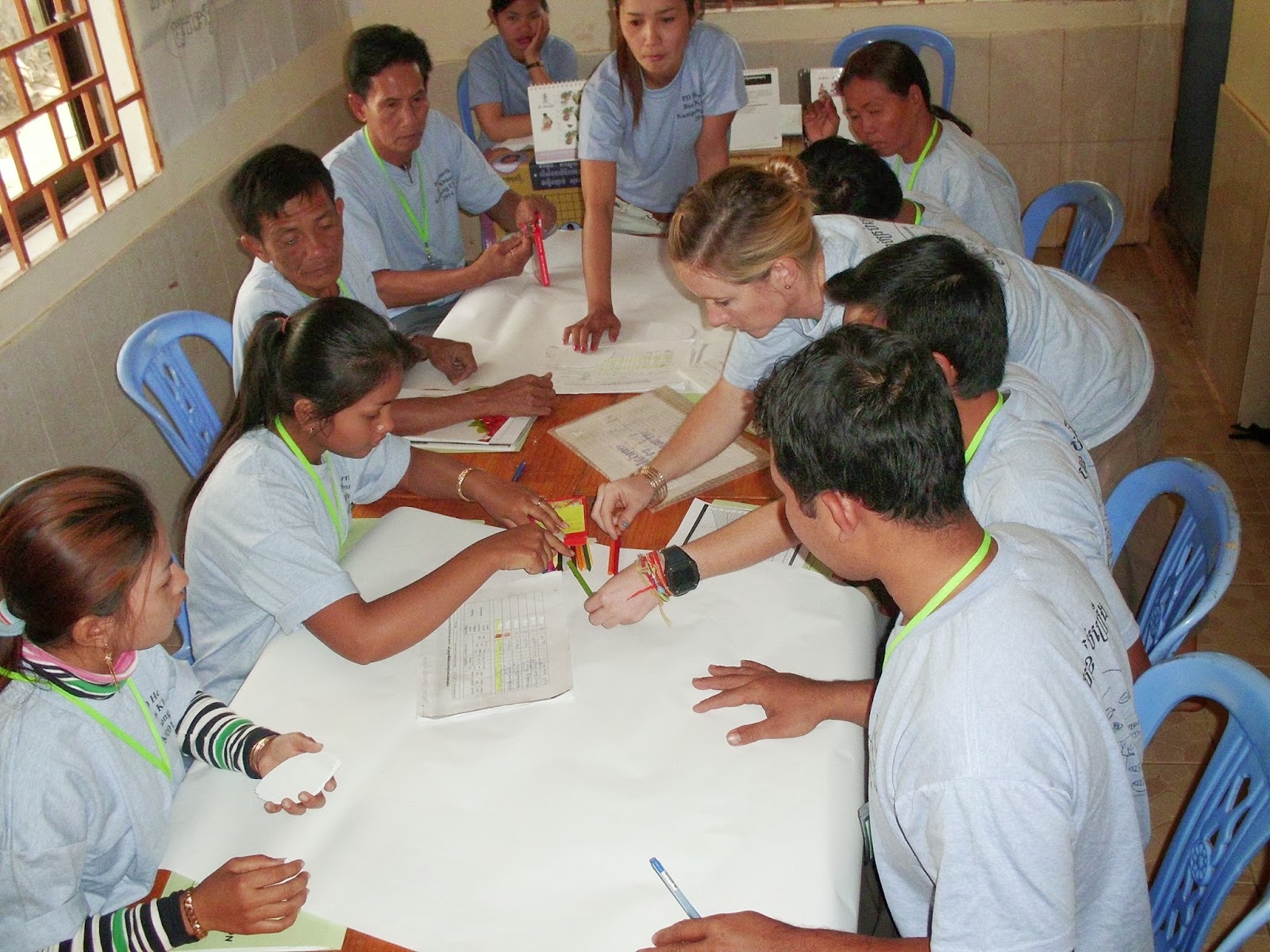
The weekend after my birthday, I traveled east to Kampong Cham to help out Caitie with a project she was running at her site: PD Hearth (Positive Deviance/Hearth).

PD Hearth is a project that focuses mainly on nutrition education.  It is a three day workshop for Village Health Volunteers during which they learn about nutrition, followed by 10 days in the village weighing children and feeding them healthy meals - like enriched borbor (a rice porridge with lots of veggies and meat in it as opposed to a plain white rice porridge with nothing but water and rice in it).

Caitie planned out all of the sessions and arranged for trainers to come and help.  I accompanied the Volunteers to a village and oversaw initial weighing session and a surveying of what mothers feed their children - the kids are weighed at the beginning and at the end, to see if they gain any healthy weight during over the course of the project.

The room is all set up and ready for the VHVs!

Trainers: a midwife from Caitie's health center and two RHAC reps.


An exercise, planning out a village and identifying locations. 

Gotta figure out which children are underweight and why!

The first weighing session in the village.


Caitie takes the lead during a session on the three food groups. (There are three in Cambodia.)

Day two: surveying parents of underweight kids to get to the bottom of the problem!

More exercises

On the last day, we made enriched borbor as a group - delicious!

On the second day in, Caitie got sick with what looked suspiciously like amoebic dysentery to me (it wasn't), and I did my best to be extra helpful.  It didn't matter - she was so organized that virtually nothing happened. Actually, there really were no hiccups in the plan.  She is that good! 

After the doubting thoughts I had about this journey on my birthday, it was great to head to Caitie's site and contribute to a project that seemed like a real success.  Cheers to learning and having some fun while we're at it, and here's to health education improving lives in Cambodia as well as all across the globe. 

xo-Amanda


Wednesday, February 5, 2014

Rabies for my Birthday

Two and a half weeks ago I celebrated my 25th birthday in Phnom Penh.

Happy birthday to me.

    Coming on the heels of my epic vacation to America, I wasn’t especially looking forward to this birthday.  Last year we had a big boat cruise down the Tonle Sap for January birthdays among Volunteers which helped  take the edge off of any homesickness and this year a lot of Volunteers, myself included, are busy with projects-starting and continuing with likely our last ones before we leave.  Plus, after being away from my Khmer family for so long, I was looking forward to holing up and playing with Avengers action figures for a little while before heading back into the city where I kept getting robbed and scared.  Looking back and now forward again, I realize that there is another, purely “Peace Corps Volunteer” reason that I almost skipped celebrating living a quarter of a century thus far: my work.

    Birthdays, if nothing else, mark the passage of time and hitting a second one here caused  me to look closer at the work I am doing more, perhaps, than the half-way mark did.  Peace Corps is a “grassroots organization” and works “from the ground up” placing Volunteers in the places where we are supposed to have the most impact: directly in villages for person-to-person contact.  During training when I first arrived, I often heard that a difficult part of being a Volunteer was that we wouldn’t necessarily get to see the fruits of our labors bloom, because it takes a long time for this direct contact that we have to make an impact we can identify with the naked eye.  I sit here day after day, doing my best to educate on health, eat rice with local people, and speak their language so to me this is just routine.  I guess I might compare it to looking at my own face every day in the mirror.  I don’t notice little changes because time is going too slowly, but if I meet up with a college friend after returning home they might notice something that I miss. 

It’s amusing and frustrating to me that getting to know people, learning their language and eating meals with them in such a way that I am supposed to have a large impact on them, gets work done so slowly that I might not be able to see it at all.   

So maybe I am getting a little too introspective for a mid-20s American woman – but in the spirit of being a person and making my mark on the world, this birthday makes me wonder if all of my planning and project-ing is worth it.  Am I providing a solution? Am I fixing a problem? Am I adding to a problem? And worst of all possibilities imagined: am I creating a problem?  There is nothing worse than nearing the completion of a contract with which my trade was two years of my American ambition and looking around to see if that two years has made a difference to anyone but me-not that it wasn’t worth it for that reason alone. 


The Friday morning before my birthday I was bitten by a dog in the village during my morning jog.  When the run had been completed, and I returned back to my ptaya, my host mom asked me if I was tired.  I told her no, but that a dog had bitten me.  She had a rather unencouraging response: with a gasp, she said something about shots, and two minutes later asked me if I had called my doctor yet.  It was about 6am.  I texted the doctor and washed and bandaged the bite and then got to work on the weeks laundry before getting a call from the great doctor herself.  She told me I had to come into Phnom Penh for post-exposure rabies shots.  I sighed.  I’m going to get rabies for my birthday, I thought, and promptly informed my host mom who called the toury man to pick me up.  In order to not zombie-out, I needed two shots given three days apart. 

In the end my birthday was saved by the people who keep me sane: my amazing friends.  The ever energetic and enthusiastic Caitie got me excited to celebrate my decades passing, and met up with me in Phnom Penh along with Andrew and Evan and they, along with a few other Volunteers, went out for a birthday dinner and drinks, ringing in my 25th in style. 

Caitie decorated our guesthouse room. She is bomb at making signs. 

Mexican food for birthday dinner!

I have the best friends. (Christin and Caitie)


Meghan and Kelly had birthdays immediately after mine.


And while I didn't zombie-out from the bite, it was a full moon that night...so I am not entirely sure werewolf-ing is out of the question.  Fingers crossed!

xo-Amanda