Saturday, March 1, 2014

Surface Assumptions

   Back home in the States, one of the most common questions I get (got?) was about my ethnicity.  Almost directly after asking for my name, I get asked a lot about my heritage.  Amused, I almost always ask the person to guess because I am interested in what other people think I look like (based solely on the fact that I get asked this question a lot).  Without fail, most people guess a combination of things and usually that combination includes an Asian guess.  Commonly included have been Japanese, Chinese, Filipina, and even Eskimo (they were serious).  After a lifetime of responses I have concluded that no one in America can tell the difference between Asians.  Just kidding. But seriously. 


   One of the best things about America (and there are ever so many), in my opinion, is the diversity. 
Earlier I had said that barang meant “foreigner.”  I was actually kind of wrong about that; directly translated, barang means “Frenchman,” but Khmer people use it as a general term for “Western-looking person.”  When people call me a barang, I say “No, I’m American,” because if I am going to be referred to as a foreigner with a nationality, it is going to be as the kind of nationality I have, thankyouverymuch. 

   When I first arrived in Cambodia I was so offended when people said this to me, and considered it extremely rude.  I think this is largely because something like this is entirely unacceptable in America (we call it “racism”).  But in a homogeneous society where everyone looks very similar (i.e. has the same stature, generally the same face shape, eye color, hair color, etc), it’s easy to spot “outsiders”: they are simply anyone who does not look like everyone else in the country.  Growing up in the States, no matter where you are from, though likely more so in cities, exposure to different types of cultures is inevitable, and along with those cultures comes diversity in faces, skin color, language, food, and other aspects of daily life.  Moving to Cambodia was a shock in the sense that instead of walking outside and encountering 7 different types of people in a 5 minute walk down the street to 4 different choices of food types, I encounter one culture, one food type, and one face type on a daily basis (what I wouldn’t do for some Mexican or Greek food right now, trust me.)
   In the beginning, when I didn’t speak a lot of Khmer, I couldn’t understand what was being said to me after the initial surprised look upon seeing my face.  Now I know that mostly what Khmer people say to me upon meeting me is moak doyk Khmer, or something like, “Khmer face.”  It happens All. The. Time. 

   It’s an interesting experience because not only am I not Khmer, I have no Asian ancestry that I know of, nor does anyone in my family ever get this kind of response (in America).  However, Khmer people think that I look Khmer or Chinese, and Thai people think I look Thai. This generally leaves me in an awkward place; I am not Khmer, and do not speak fluent, correct Khmer, but I am not wholly a barang (in Khmer eyes) because I have a nationals’ face but barang skin.  Sometimes though, I am mistaken for a Khmer person and often blend in.  I am quite literally stuck between two worlds.  

Let me recount some interesting (but not singular) instances:

   I was at Amber’s house in Kampong Chhnang working on the ANC Project, and I met her host mom who immediately commented on my Khmer-looking face (Shocker).  Later that day, during the evening meal, she gestured to my hands and told me I had Khmer hands because clearly I worked with them.  Then she gestured to Amber’s hands and told me her hands were American because clearly she did not work with them. 
   She made me laugh but she also revealed what she thought about Americans: mainly that we don’t work like Khmer people do.  Granted, manual labor has never been one of my after-school or summer jobs, and I don’t work over a stove all day (or ever) like a lot of Khmer women, but I like to think that I and my brethren work very hard.  Also, I wondered, what is it that we’re doing here? Vacationing?

   When Diana visited we were in Thailand for a few days and during the last day we went to see a golden Buddha.  While there, a Thai man commented to Diana and I that we had the same face (we get told that we look alike A LOT).  We nodded, as we generally do.  Then he proceeded to tell me that I had a Thai face.  

Really?  Did Diana? No.

How does that even work?

The same thing happened at my site.  When my host mom and grandmother met Diana they told me that we looked a lot alike but that I had a Khmer face and Diana did not.  Great, because that makes complete sense. 

   Having been asked a lot about my heritage in America, and having been told that I look Khmer and Thai and Chinese in this part of the world, I have come to realize that the questions are asked (or stated) with different intentions.  In America it’s more a curiosity; a question designed to pinpoint a facial feature, perhaps.  My ethnically ambiguous face doesn’t stand out in a place where diversity is the rule rather than the exception.  It’s interesting (beauty does that to people) but in the sense that it’s a small-talk conversation topic and not much more.  In Asia, Khmer people telling me that I look Chinese means something else entirely.  Khmer people telling me I look Khmer when they learn I am from America means something else as well.  It’s not simple curiosity here in a place where everyone has the same face; it means something.  And not being from here, I don’t exactly know what that something is. 


   On my toury ride from Kampong Chhnang, I met a Khmer lady who (Shocked again!) exclaimed immediately upon looking at my face that I had such a Khmer face.  I nodded and told her that I get that a lot.  She asked me where I was from and I responded that the States was my place of origin.  She paused before telling me that I didn’t look American, I looked Chinese and Khmer, more Chinese than Khmer though.  “No, I’m American,” I said to her, to which she responded, “Kom jooh” (I don’t believe you).   This was new.  I considered her for a moment before asking her what, exactly, did Americans look like?  In a voice that clearly confirmed my status as an imposter, she told me that first and foremost, Americans were beautiful.

I pretended not to be insulted.

   Then I filed that tidbit away in my memory for when someone back home had a pity party.  Now now, I could reason with them, a source in Cambodia has told me that you are beautiful, and other such stuff.
She went on to describe Reese Witherspoon and other such celebrities that may have descended from the Vikings, all of them with eyes as blue as the ocean and flowing golden hair – generally towering over the rest of the population with an impressive Thor-like build. 


   I was at first a little concerned.  When I imagine home, “home” being the United States of America, which I have traveled and lived in many different cities in different parts of the country, I never imagine one type of face or body type.  Usually a few different friends and family come to mind and with them, every different eye color, hair color, body type, skin color, language and religion I can possibly envision.  Americans have the reputation of huge egos and maybe getting fat, yeah yeah, but typical “blonde hair, blue eyes” was the best she could come up with?  How disappointing.  It was at that point that I realized just how much of a difference there is between “looks” at home and “looks” in Cambodia.  In America, “beauty” has a rather broad definition and is focused a lot on the body – the media and whatnot are forever commenting on “thin” this person “fit” and “healthy,” or “overweight” such and such.  In Cambodia, people comment a lot on faces.  There are the “fat” and “skinny” identifying words or whatever but people don’t really go on about my “fat” body; they love talking about my face. 

   During another random incident, I was in the health center of my village, sitting in the ANC room with some of the midwives when a woman came in and sat down next to me, speaking rapid Khmer to the staff.  They spoke for a few minutes, she left, came back, and sat back down.  After another minute or so, she looked at me, did a double take, and exclaimed, “Ah! Barang doych Koray!” or something of the sort, pointing out that I was a foreigner and then telling me that I looked Korean.  I told her I was American.  After that, the midwives studied me, trying to decide if I looked Korean or not.  I got a 50% “yes” on that question.

Well that was new too. -Ish.


   Flying from Phnom Penh to Beijing, I sat next to this adorable older Chinese couple.  They both had US passports, which I noticed – as did a lady who sat behind us.  This lady thought that they were my grandparents and probably that we were going to see my ancestral home or something.  I thought this was hilarious (I played along – have you learned nothing about me yet?).  Actually, (I talked to them a bit) they were US citizens, but had lived in a few different places around the world and spoke better Khmer than English.  We proceeded our conversation in Khmer and via my terrible Khmer, the grandmother taught me a few words in Mandarin - of which I remember exactly one.  That was pretty cool.  Anyway, the lady thought that I was their grandchild, of Chinese descent, whereas the couple knew I was not Chinese, and because I was speaking rather rapid English to the lady behind us, thought that I knew her instead.  What a tangled web we weave, am I right?

   On the flight from Shanghai to Beijing I sat next to two American ladies conversing in French.  Not thirty minutes into the flight, one of them turned to me and asked, “What’s ‘Mickey Mouse’ in Chinese?”

   At that moment I was suddenly hit with two simultaneous thoughts.  The first thought was an immediate worry that the face I see in the mirror (at least once a week) is not the face that the rest of the world sees, a notion which (despite endless inquiries about the ethnic ambiguity of my face throughout my life) had never occurred to me before.  The second thought was that “Mickey Mouse” in Mandarin was the sort of common knowledge that everyone should know-akin to knowing that Paris is the capital of France or that Michelangelo painted the ceiling of the Sistine Chapel-an example of something prime missing from my childhood education (and if this was the case, then what else had I missed; the story of Father Christmas in Swedish? the origins of the Easter Bunny?!).

“I don’t know” I said to her.

She didn’t even pause, “Is it *insert-Mandarin-sounding-word-here*?”

The look on my face was blanker than a Khmer person’s when I speak English. “I don’t know” I repeated. 

She gave me a look that said she didn’t believe me and turned back to her friend. 

   I have never met anyone in all of my travels who would not willingly translate a small word or phrase if they were asked and spoke both languages and was offended that she thought that I would not share information like that if I had known it.  What was I supposed to do? I really don’t know anything in Mandarin except for “hello” and thank you”, both of which I may or may not mispronounce unintentionally at every opportunity.  People aren’t just mean like that, and despite the fact that we were in China, she was surrounded by people from the tour group.  Not only that, I’m not Chinese.  Wonder of wonders that she should meet someone on an airplane surrounded by a tour group who, like her, doesn’t speak Mandarin. 
   It wasn’t until she gave me that look that it dawned on me that she thought there was Chinese in me and by default of my Chinese-looking face, I must speak Mandarin. 


   Thus the lessons.  What all of this has taught me is nothing about my looks and everything about assumptions.  People assume so many things based on my looks; that I’m Khmer, that I’m a Japanese/Eskimo combination, that I speak Mandarin.  It was funny in the beginning, and I play around with it when I get the chance, but mostly, when these things happen (and boy do they happen) I get a little twinge of homesickness, and I think of “home” the US, where I do get the question of my ancestry a lot.  It’s just curiosity though, and whoever asks it is asking with interest how my face was assembled – which backgrounds came together to make me.  The idea of questioning whether or not I am American is never even an idea. 


   The truth of it is that it doesn’t matter what my ethnicity is.  I had thought about owning up to it on this blog, but after composing a small paragraph, I read it over and thought to myself, who cares?  It’s not important.  You know what’s important? -Health messages that I attempt to pass on to my village, encouraging basic and continuing education, spreading knowledge of my own country to these people and their culture to my own.  The whole point of this blog post is that it boils down to two questions: Why does it matter if I look Khmer or if I don’t? Would my message mean less if I were Khmer? 

And I think that is a huge reason Peace Corps is important.  To spread the idea that the message, the knowledge, the learning is what is important, not the vehicle that is used to spread it. 

But if you ask me where I am from, I am still going to say “America,” and if you ask me about my heritage, I am still going to ask you to guess first.  After all, I might as well have some fun with my face, and get a story out of it. 

xo-Amanda


Thursday, February 13, 2014

PD Hearth

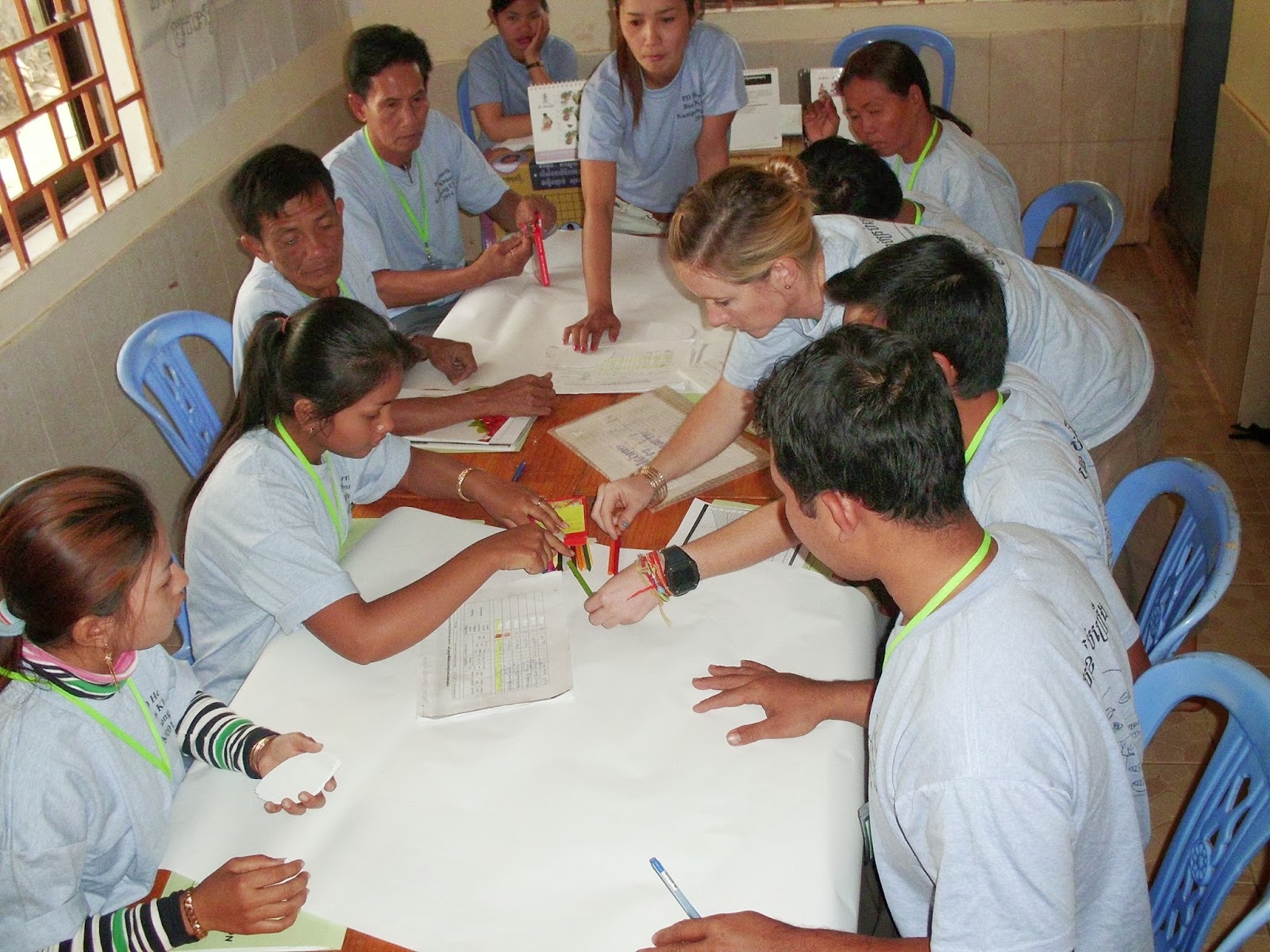
The weekend after my birthday, I traveled east to Kampong Cham to help out Caitie with a project she was running at her site: PD Hearth (Positive Deviance/Hearth).

PD Hearth is a project that focuses mainly on nutrition education.  It is a three day workshop for Village Health Volunteers during which they learn about nutrition, followed by 10 days in the village weighing children and feeding them healthy meals - like enriched borbor (a rice porridge with lots of veggies and meat in it as opposed to a plain white rice porridge with nothing but water and rice in it).

Caitie planned out all of the sessions and arranged for trainers to come and help.  I accompanied the Volunteers to a village and oversaw initial weighing session and a surveying of what mothers feed their children - the kids are weighed at the beginning and at the end, to see if they gain any healthy weight during over the course of the project.

The room is all set up and ready for the VHVs!

Trainers: a midwife from Caitie's health center and two RHAC reps.


An exercise, planning out a village and identifying locations. 

Gotta figure out which children are underweight and why!

The first weighing session in the village.


Caitie takes the lead during a session on the three food groups. (There are three in Cambodia.)

Day two: surveying parents of underweight kids to get to the bottom of the problem!

More exercises

On the last day, we made enriched borbor as a group - delicious!

On the second day in, Caitie got sick with what looked suspiciously like amoebic dysentery to me (it wasn't), and I did my best to be extra helpful.  It didn't matter - she was so organized that virtually nothing happened. Actually, there really were no hiccups in the plan.  She is that good! 

After the doubting thoughts I had about this journey on my birthday, it was great to head to Caitie's site and contribute to a project that seemed like a real success.  Cheers to learning and having some fun while we're at it, and here's to health education improving lives in Cambodia as well as all across the globe. 

xo-Amanda


Wednesday, February 5, 2014

Rabies for my Birthday

Two and a half weeks ago I celebrated my 25th birthday in Phnom Penh.

Happy birthday to me.

    Coming on the heels of my epic vacation to America, I wasn’t especially looking forward to this birthday.  Last year we had a big boat cruise down the Tonle Sap for January birthdays among Volunteers which helped  take the edge off of any homesickness and this year a lot of Volunteers, myself included, are busy with projects-starting and continuing with likely our last ones before we leave.  Plus, after being away from my Khmer family for so long, I was looking forward to holing up and playing with Avengers action figures for a little while before heading back into the city where I kept getting robbed and scared.  Looking back and now forward again, I realize that there is another, purely “Peace Corps Volunteer” reason that I almost skipped celebrating living a quarter of a century thus far: my work.

    Birthdays, if nothing else, mark the passage of time and hitting a second one here caused  me to look closer at the work I am doing more, perhaps, than the half-way mark did.  Peace Corps is a “grassroots organization” and works “from the ground up” placing Volunteers in the places where we are supposed to have the most impact: directly in villages for person-to-person contact.  During training when I first arrived, I often heard that a difficult part of being a Volunteer was that we wouldn’t necessarily get to see the fruits of our labors bloom, because it takes a long time for this direct contact that we have to make an impact we can identify with the naked eye.  I sit here day after day, doing my best to educate on health, eat rice with local people, and speak their language so to me this is just routine.  I guess I might compare it to looking at my own face every day in the mirror.  I don’t notice little changes because time is going too slowly, but if I meet up with a college friend after returning home they might notice something that I miss. 

It’s amusing and frustrating to me that getting to know people, learning their language and eating meals with them in such a way that I am supposed to have a large impact on them, gets work done so slowly that I might not be able to see it at all.   

So maybe I am getting a little too introspective for a mid-20s American woman – but in the spirit of being a person and making my mark on the world, this birthday makes me wonder if all of my planning and project-ing is worth it.  Am I providing a solution? Am I fixing a problem? Am I adding to a problem? And worst of all possibilities imagined: am I creating a problem?  There is nothing worse than nearing the completion of a contract with which my trade was two years of my American ambition and looking around to see if that two years has made a difference to anyone but me-not that it wasn’t worth it for that reason alone. 


The Friday morning before my birthday I was bitten by a dog in the village during my morning jog.  When the run had been completed, and I returned back to my ptaya, my host mom asked me if I was tired.  I told her no, but that a dog had bitten me.  She had a rather unencouraging response: with a gasp, she said something about shots, and two minutes later asked me if I had called my doctor yet.  It was about 6am.  I texted the doctor and washed and bandaged the bite and then got to work on the weeks laundry before getting a call from the great doctor herself.  She told me I had to come into Phnom Penh for post-exposure rabies shots.  I sighed.  I’m going to get rabies for my birthday, I thought, and promptly informed my host mom who called the toury man to pick me up.  In order to not zombie-out, I needed two shots given three days apart. 

In the end my birthday was saved by the people who keep me sane: my amazing friends.  The ever energetic and enthusiastic Caitie got me excited to celebrate my decades passing, and met up with me in Phnom Penh along with Andrew and Evan and they, along with a few other Volunteers, went out for a birthday dinner and drinks, ringing in my 25th in style. 

Caitie decorated our guesthouse room. She is bomb at making signs. 

Mexican food for birthday dinner!

I have the best friends. (Christin and Caitie)


Meghan and Kelly had birthdays immediately after mine.


And while I didn't zombie-out from the bite, it was a full moon that night...so I am not entirely sure werewolf-ing is out of the question.  Fingers crossed!

xo-Amanda

Thursday, January 30, 2014

The Great American Vacation

It started with a toothache. 

For Christmas, my parents got me the greatest gift a PCV can get (besides Western food, a cold glass of good beer and a long hot shower): a trip back to America for the holidays.  I planned to leave a day early in order to be sure to catch my flight and then it happened:  I had to go to the dentist.  I always have to go to the dentist.  Because of this I had to go into Phnom Penh a day earlier than planned. 

Imagine you have spent the last year and a half in a third world village and you were looking forward not only to seeing  your family and friends, but celebrating the holidays with them amidst snow and Christmas and first world food.  Imagine you had been looking forward to this trip, had packed to a T and were ready to jet set back home for a vacation. 

Now imagine the worst possible thing that could happen.

It doesn’t take a genius to figure out what happens next: I was robbed. Again.

This time they got my passport.


I was on my way to the dentist at 8:30am and wearing a money belt so all they got were things that I expressly needed to get out of the country: money, access to money, and my passport. 
I remember curling up, sitting on the ground as I sobbed into the phone, “They have my passport, I’m supposed to go to America tomorrow!” while attempting to relay what had happened to the Safety and Security Officer.  It was Saturday morning, my flight was Sunday night.  The embassy was closed and so was the Peace Corps office. 
In a few minutes, Khmer people surrounded me and someone located a policeman.  They must have chosen a spokesperson who could speak English because a man sat down next to me and asked me some questions.  I surprised everyone by answering in a mixture of Khmer and English – one language wouldn’t satisfy me at this point.  I could barely think in English so there was no way this would get done in Khmer. 
One of the boys on a bicycle had come over and offered his opinion.  He told me that the men on the moto had followed me for minutes, maybe even from my guesthouse (I had been walking for about half an hour), waiting for the moment when I was distracted or careless to snatch my belongings from my body. 

Which was great because that’s exactly what a girl alone who just got robbed wants to hear: that she’s stalked prey. 

Just in time, my guardian angel arrived in the form of another PCV, Christin.  She helped me get to the police station, file a report, and figure out all things that were necessary for me to do in order to get out of the country the following day. Without my passport. 
When a Volunteer officially joins Peace Corps, they send in their passport and receive separate one – we call it a “Peace Corps Passport” and the original one a “Tourist Passport” so I wasn’t as lost as a tourist might have been because I actually had a passport to leave. The problem was that all of my visas making my stay in Cambodia legal were in the stolen passport.  So if I tried to leave the country with a passport that I didn’t arrive with, there would be no entrance stamp, and if there was no entrance stamp, Cambodian police might wonder how I got into the country, when, why, what I had been doing, and all sorts of questions that I don’t have enough Khmer for. 
Luckily Peace Corps really came through for me, pulled out all the stops, and managed to get me out of the country on my original flight.  Which, in the end, is what really matters, right?

I remember sitting on the plane in Phnom Penh about midnight that Sunday night after what may well go down in my history as the worst weekend of my Cambodia experience (and I am generally an optimist) and wondering if I was dreaming.  I did.  I sat there and wondered if it was real life that after what had happened that I was actually going to get back to the States for the holidays.  There is a very small part of me that still thinks my visit home was an extensive daydream. 

Getting back to America was overwhelming, to say the least.  It was a mishmash of a million different emotions all at once: comfort and change chief among them.  My sister picked me up from the airport and as we were heading out of the parking lot, I commented on her hair.  Our exchange went like this:

“Oh, I like your hair, did you get a haircut?”
“No.”
“…in the last year and a half?”
“Haha, well yea.”
“Ok then, I like your hair!”

That car ride to vacation set the stage for the reverse culture shock that I was about to experience.  Perhaps, on second thought, just the realization that I was over a year behind everything that was going on was what really happened.  I think that on some level, all Volunteers, though we know that life goes on, have this small idea in our heads that the life we traded when we left America for two years freezes and waits for us until we return.  It isn't until we encounter the remains of the lives we left behind for our own grand adventure, that we realize just how far away we really are.  

I never before realized just how much I missed sports until I got back and was able to watch literally any sport I wanted on a couple hundred different channels.  Football, basketball, hockey, O my! Am I even that big of a football fan? Who cares, sports! Give me any team playing any other team and I will be super content.  I even got to see the Bulls and the Blackhawks play at the United Center while I was home (Thanks, superfamily!) Nothing beats live sports, especially when they have been seriously absent from your life for over a year. 


And then there were the social situations, the incredibly awkward social situations.  I am kind of a socially awkward person anyway, and my distance from American culture for the last year and a half hasn’t lent anything in terms of cures to this predicament.  I remember sitting with a few friends at lunch one afternoon listening to them talk about a bunch of different random things, mostly involving pop culture – a reasonable lunchtime conversation.  As I sat at the table and listened to people, I realized that I had no idea what they were talking about it.  It was incredible.  And not only that, I wanted to ask what seemed like very dumb questions probably showing them just how out of the loop I was.  For example, hashtags on TV shows - that's a thing now! Was it when I left? Hashtags are all over TV. And then there's the music - everything on the radio was new to me, and all of the artists were new as well.  I remember texting a friend about all of this new music I saw on TV New Year's Eve.  "Who was it?" he asked, and I responded, "I don't know but they kept singing 'safe and sound' over and over so I assume that's the name of the song." Yea. That song* is huge in America.  You know who it is. 

I was torn, too, regarding my own Peace Corps life, suddenly far away itself.  Generally, when I talk to friends and family back home, they inquire about my host family and any new projects and then we move on to American life and general catching up.  Talking about village life, for me, is kind of like this: you know how when you're in class, studying something really intensely, and then you go home after class or whatever and the last thing you want to do is talk about that class?  I've been in class for a year and a half already, 24/7.  Can we talk about something else?  But then again I was torn - yes, please let me tell you about my awesome host family, did I mention I have photos *pull out about a few photo books of my host mom and Khmer brothers*? By the way I am starting this new project, any ideas on how to improve it?  

It's hard to continue a conversation when someone asks me, "What is Cambodia like?" or "Tell me everything about village life!"
Really? Do you have about a year to listen? Can you rephrase your question and be a bit more vague?  
But even those are ridiculous thoughts - my friends and other people I met were genuinely interested in what was going on, hearing about differences and similarities, finding out how people on the other side of the world live, they just didn't know what questions to ask, or how to get to what they really wanted to hear about.  


But enough complaining about the best vacation ever - because it really was just that.  I got to see friends and family, stuff myself silly with delicious food, enjoy hot showers and cold beers (not simultaneously), and even skiing and snow-playing.  Nothing beats Christmas morning with the family or drinks with my brothers and sisters.  

Then I got back to Cambodia and re-assimilated right back into Khmer life. Because really, I am where I am supposed to be.  And America life will be there for me when I come back after this stint, more prepared to reintegrate.  See you again, USA, in about 6 months.  Get excited. 


xo-Amanda

*Safe & Sound by Capital Cities

Sunday, January 19, 2014

China and Cambodia

     As much of a history nerd as I am, most of my interest lies in the more ancient of histories and centers primarily on the Western world (think ancient Greco-Roman), and if you are going to quiz me on my history knowledge, try and remember that my main historical interest lies in warfare.  When I was growing up I would go through what I call, “history phases” during which I would get super into one particular epoch of history for a little while, say a year or so, just gobbling up as much information about that historical period as I could before I eventually got tired of it or wore out all of my resources and moved on to a new historical period.  Most notable were my Revolutionary War phases (4th grade, 6th grade, and again in high school), my Civil War phase (5th grade-8th grade) and my Henry VIII phase (which was really more like my Henry VIII’s Six Wives phase which lasted the longest and carried on into my Elizabeth I phase).  You know how when you are looking things up on the internet, say Wikipedia which has all of these convenient links that let you just jump from page to page and acquire knowledge about albino models when you started with search words “Apple Inc.”, and three hours after you start you realize that you have been looking at Game of Thrones characters when you started with “Peace Corps grants”? That’s how history and I are.  So when in grade school I fell into a Chinese history phase, I made it through one book about medieval Middle Kingdom and then was pulled into the California gold rush.  That and seeing “Made in China” on a lot of my toys was about as much as I was exposed to anything about the closed and mysterious country that occupies a large portion of the Asian continent, and I think I had a pretty well-rounded education.  So before I traveled to the wondrous country that produces 19% of the world’s population and with limited internet access and electricity that is the fact of my site, I did as much researching into China and Chinese history as I could stomach.  And let me tell you, China is pretty amazing. 

     However, while history books perpetually keep me occupied like a kid on a computer game, and though I thoroughly enjoyed seeing the more historical aspects of the super old Beijing, it was cultural and personal facets of my Chinese trip that I noticed more.  Maybe it was due to the fact that I live in an Asian culture right now, or maybe it was because Cambodian culture has been influenced by Chinese culture – whatever the reason, I took in more cultural types of characteristics of China while I was there, more so than I have with other cultures like Greek (OMYGOSH now if you want to study ancient history, that is the place to go! And yes, I went there.)

     Even as I admit that my favorite part of my China vacation was seeing my parents, it did give me an opportunity to experience a culture that has a bit of influence on the one I am currently entangled in. Granted, since we were on a tour we went places that the tour company had decided upon (likely influenced by the all-seeing government), and witnessing “authentic” Chinese culture was not really on the menu.  Instead we visited places (photos posted in previous blog) of historical significance, modern marvels, and natural phenomenons.  Most of what we saw was pretty well known throughout the rest of the world, famous or infamous or what-have-you.  Though the guides we had were super funny and very entertaining, what was most interesting was what they told between stories of cultural magnificence, and while I couldn't help but gaze in wonder  at the enormity of the Forbidden City or the splendor of the Chinese countryside from the top of the Great Wall, the most interesting aspects of my trip were times like seeing Chinese Buddhist monks walk by with different colored robes on than Cambodian Buddhist monks, or noticing the distinct lack of children playing on the streets when I am used to seeing children everywhere in my village. 

     China and Cambodia have a long intertwined history, one that I don’t really understand well enough to try and write about on this blog and sound credible.  Most of what I know about this relationship has been told to me by Khmer people in Khmer, so even then I might have misheard or missed unknown words between the words that I do know during long but simple conversations.  I do celebrate Chinese New Year with my host family, and go to the Wat with them for religious festivals.  I have also been told by Khmer people that I look more Chinese-Khmer than just Khmer alone (which is a compliment of sorts because Khmer people consider Chinese to be very beautiful).  And while I am certain that there is significant economical and historical significance in Chinese influence on Cambodia, it hasn’t yet tempted me to read long articles on this relationship or delve into the mysteries of a Chinese-Khmer culture. 

There were some similarities that I found interesting, and even more striking (as they always are) were the differences. 

     The whole world knows about China’s One Child Policy which, due to the booming population, restricts couples to having one child and being limited in other opportunities should more than one child be born.  This policy was never actually written into law (check out this site where I got my facts or Wikipedia, of course), but was put into effect in 1979 due to some serious social and economic problems based on China’s incredible population growth.  It focuses on delayed marriage and child bearing, fewer and healthier births, and one child per couple.  Sidenote: my mother and I were curious about cases of twins so we asked a guide and he told us it was technically “one birth” so if a couple had twins they didn’t have to pick their favorite and get rid of the other one.  However couples are at a disadvantage when they have more than one child so it was ideal to just have one.  Recently, the Chinese government has noticed certain social and economic problems arising from their solution to previous social and economic problems in the form of an aging population and a serious gender imbalance, to give a few examples, and so have come up with a policy that allows couples who pass certain requirements (they are an only child themselves, for example) to have a second child. 

     Growing up in a family with 4 siblings myself and countless cousins (well OK, I can count them but we are getting more and more all the time so what’s the point?) due to the fact that my father is the oldest of 8 and my mother has 2 brothers herself, I cannot even imagine what being an “only child” is like.  Even though I have friends without siblings it is still difficult for me to understand.  Siblings are so great; built-in playmates, forever best friends, they have to love you even if they don’t like you, etc.  I guess that is just my view though, so please continue with whatever thoughts you have of your own siblings.  My point is that it is a hard concept to grasp for one so encircled as I am with family.  Even in Cambodia, I have two little host brothers who are my best friends in my village – possibly because we have the same language abilities and most of our communication is done via Avengers games and me giving them candy, but whatever.  Siblings are the best.

     Due in part to Cambodia’s recent Khmer Rouge history in which about a third of the populace was slaughtered, a large part of the current Khmer population is very young.  Working in the health center with pregnant women, it is even easier for me to see the boom happening that results in children everywhere in my village.  Not just that, they are everywhere in cities too.  All the time and everywhere I go here, I see children playing, children on their way to school, children this and children that, they are really everywhere.  So it was especially striking to me that we didn’t see very many in China.  Of course, there are a million and one reasons why we wouldn’t see any including the fact that we went to many tourist places and they were probably in school, but just the difference coming from a kid-laden country to what seemed to me sometimes as a kid-free one, it was something I really noticed. 


     Something that was impossible to ignore was the food. Obviously. If you know anything about Chinese food you probably know that Panda Express is not “genuine” Chinese food.  Delicious, yes. Chinese, no.  We were able to have “traditional” Chinese food prepared by a village family once during the trip and not surprisingly, it was absolutely delicious, nothing like Chinese takeout, and considerably similar to Khmer food that I eat every night in my village.  We were also fed Chinese takeout-like food on the tour except it was not as good as Panda.  One night, sitting around a large table full of this kind of food, one of the members of the tour asked me if I ate anything like the takeout-like food before us on the table in Cambodia.  I said no, and then took a moment to consider the food on my plate.  It was exactly the same, except for the fact that the food before us was engulfed in sugary sauces (akin to the kind that covers orange chicken or sweet and sour sauce) whereas for dinner in my village, my host mom just gives me rice and veggies or meat -no sauce necessary.  What was interesting was that they kept serving us what is commonly accepted as “Chinese food” in America.  They could have served us the good stuff.  We were there for the experience, after all.  

     As with many great nations, mine included, Chinese culture is infused with a superb sense of national pride which was easy to see everywhere we went.  It wasn't just that the achievements were on display for us to see, but the Chinese people we saw and met with were every bit as in love with their country as I am in love with mine. And truly, Chinese people have a lot to be proud of from their ever expansive and incredible history to changes they are making now.  

xo-Amanda 

Monday, January 6, 2014

Destination: China

In November I was able to take a vacation and meet up with the Superparents in China.  It was a vacation for the books. 
We went with a tour group with great guides around to four different cities: Beijing, Souzhou, Hangzhou, and Shanghai for a total of about 10 days.  It was quite a change from the third world Cambodia I was used to...mostly because China has winter! 
We were able to see the Summer Palace (above)

Some of the older folks practiced their calligraphy by painting with large brushes and water on the ground.  It dried right up and they started all over again. 

This was one of my favs.  I can imagine a conversation between two builders: 
"What shape should we make the windows?" 

"...All of them!"

Tienanmen Square: the Square you have heard so much about...maybe.
It really is as big as they say.  

The Forbidden City was by far the largest complex I had ever seen in my entire life, and supposedly it housed only the royal family! Beyond gorgeous, though. 

The animals on the rooftops signified status, so only emperors could have this many animals while peasants and others might have only one or two.  I thought that was pretty interesting.  


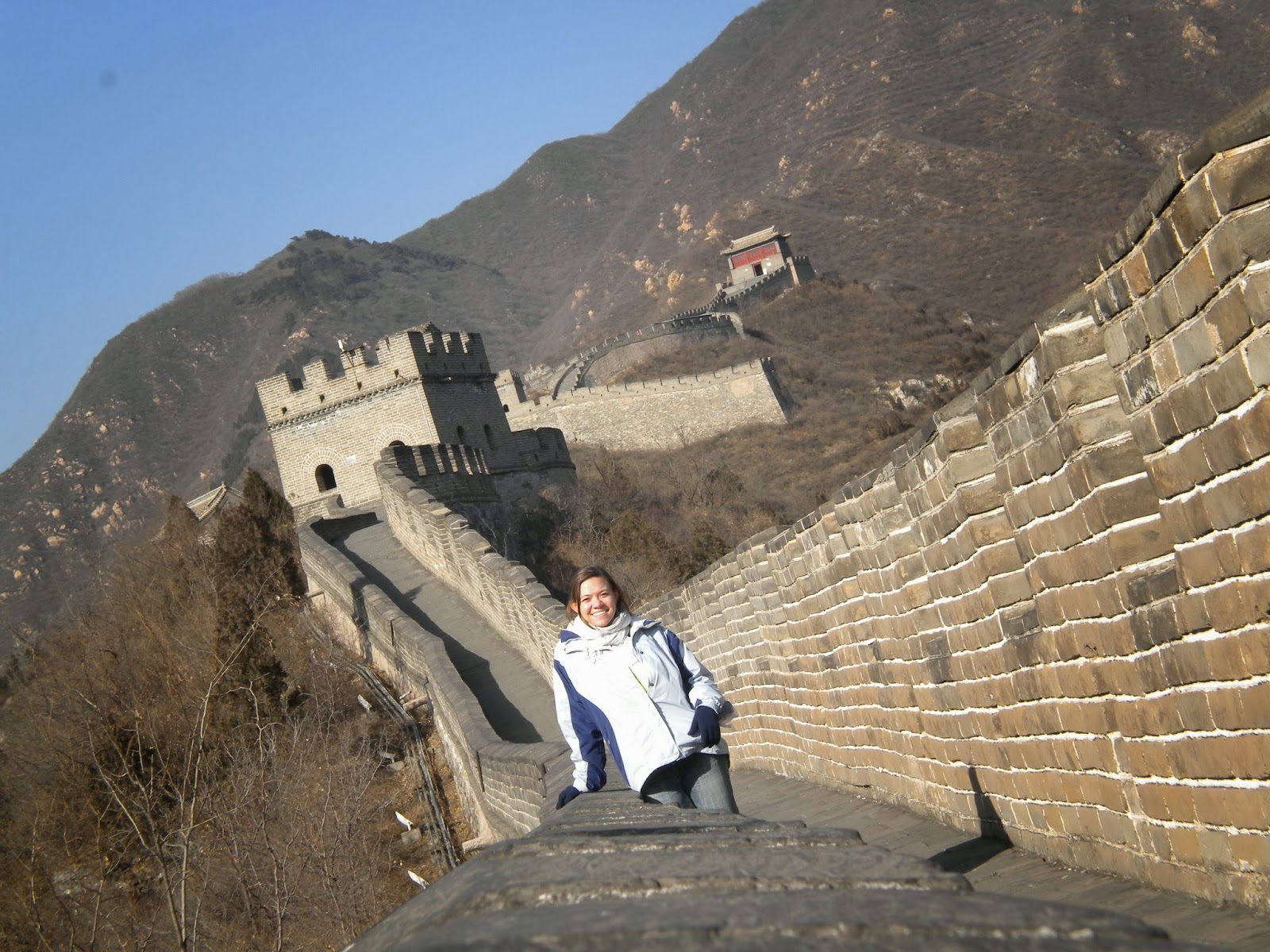
One of my favorite parts of the trip was CLIMBING THE GREAT WALL OF CHINA!!!!
The view was truly amazing and how many people can say they have meandered along the Great Wall? In America, I mean.  

Dad was pretty happy we made it.  


And I took some of the best timed selfies EVER. Because when everyone you're with makes it to the top, says "Yay, we made it" and then heads back down...you know the right thing to do is to continue on by yourself.  I mean, it's the Great Wall of China!

We got to see the Bird's Nest from the Olympics,

the Temple of Heaven (who doesn't want to visit a place with a name like that?!)


And a randomly cool thing we saw was the residence of the recently deceased King of Cambodia, Sihanouk.  We were on the bus on the street when the tour guide pointed it out and I kind of gave a little gasp and realized that I was probably the only one who knew the history of the man who had lived there.  I tried to explain to the people around me on the bus but maybe you will have better luck if you Google it.  He was welcomed in China when he was deposed and gave up the crown a few separate times in his history.  I will dive a little bit more into this in a separate blog about Khmer history.  

We took a rickshaw around some of the older parts,

Where they gave us great deals.

And saw some moon doors!


A really cool trip was down a river in Souzhou where we were able to head to a "traditional market".  Upon arriving, I noticed how much bigger and cleaner it was than the market in my village in Cambodia!


And we also headed to a silk factory in Souzhou where we were able to observe how the silk thread is taken from cocoons.  


Family pics in gardens happened,

And we got advice from Confucius.  

Saw where famous Chinese tea was grown on a tea plantation,


and had a great view of Shanghai at night.  

We got to ride the fastest train in the world! 

which apparently could get up to speeds of 500km/hr given enough track...but due to the length of the track that was built, 431 km/hr was close to as fast as we got.


And so to finish this blog, I leave you with promises of comparison descriptions later, as well as these gems- which will show you how to dress if you are a tourist during a rainy day (of any country of your choosing), 


a perpetual thought to keep in your head:


the last place I visited in China: a lit market.  


and a rare but adorable sighting of a Chinese child. 


And I got to see the Superparents! Best vacation ever. 

Cheers,
xo-Amanda